
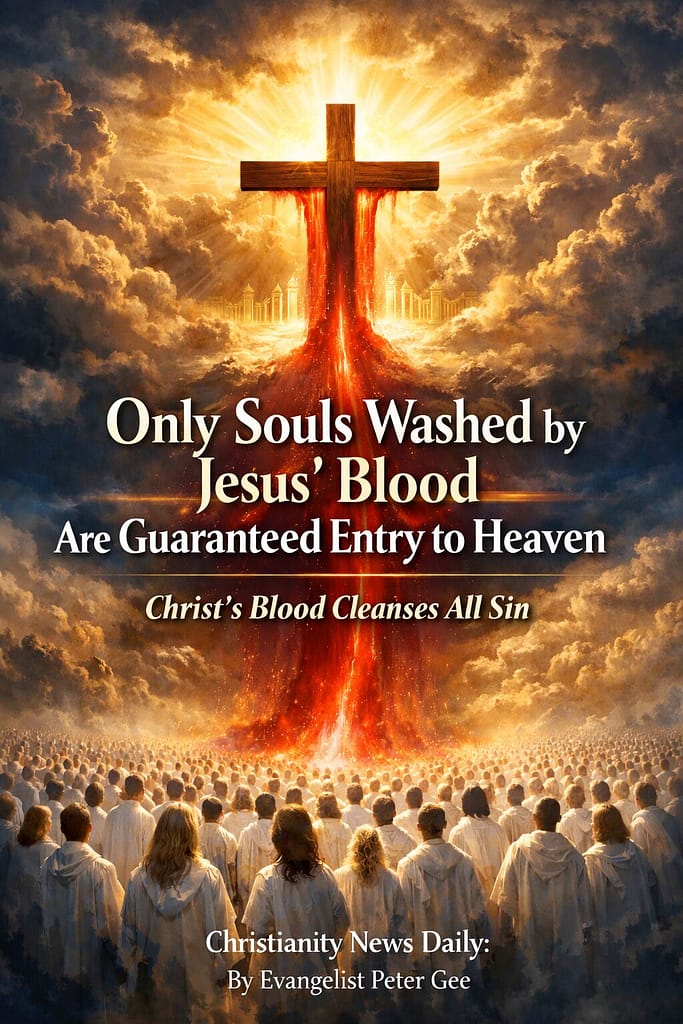
Scripture presents the blood of Christ as effectual. It saves. It redeems. It cleanses. It reconciles. It justifies it. It sanctifies. It provides boldness to approach God. It overcomes Satan, the accuser. It establishes peace between God and Man, and it’s the only guaranteed entry to heaven by anyone who desires to dwell with God.
By Evangelist Peter Gee, Editor in Chief, Christianity News Daily
04/15/2026
The blood of Jesus Christ is central to Christianity. It is the foundation of forgiveness, the remedy for guilt, and the sole means by which anyone can stand before God. Without it, the gospel loses its power. Rejecting the blood of Christ is to reject the only sacrifice God has accepted for sin.
For this reason, the message of Jesus’ blood must be proclaimed clearly. Humanity requires cleansing, atonement, reconciliation with God, and forgiveness of sins. Scripture affirms that these are found only in the shed blood of Jesus Christ.
Many desire heaven without the cross, eternal life without repentance, and peace with God without acknowledging the sacrifice that made it possible. The Bible offers no alternative paths to God and does not claim that sincerity, church attendance, or human effort can remove sin. Scripture points to one Savior, one sacrifice, one Lamb, one cross, and one cleansing blood.
Speaking of Jesus’ blood acknowledges the cost of redemption, where divine love meets justice and the spotless Son offers Himself for sinners. His blood is precious because He is; powerful because He is eternal; sufficient because He is perfect; and effective because God has accepted it.
Why the blood of Jesus matters
Throughout Scripture, sin is shown to bring death, and without the shedding of blood, there is no forgiveness. Sin is not trivial to God; it is lawlessness, rebellion, and an offense against His holiness. Because God is holy and just, sin cannot be ignored or guilt dismissed without satisfaction. Human merit alone cannot grant access to His presence.
Hence, the theme of blood runs throughout Scripture. After the fall, sacrifice is introduced. Abel’s offering shows that approaching God requires what He accepts. The Passover demonstrates that judgment passes over only where blood is applied. Levitical sacrifices illustrate substitution and atonement, but they were only foreshadowings of Christ’s coming.
When John the Baptist saw Jesus, he declared Him to be the Lamb of God who takes away the sin of the world. That statement brings the Old Testament sacrificial system to its fulfillment in the person of Jesus Christ. He is the Lamb. He is the sacrifice. He is the sin-bearer. He is the One whose blood truly cleanses.
Animal sacrifices never fully removed sin; they pointed forward to Christ. Jesus did not merely symbolize redemption; He accomplished it. His blood secures eternal redemption, not just temporary covering.
The problem every soul must face: sin before a holy God
To understand the power of Jesus’ blood, one must grasp humanity’s problem. Scripture exposes all as guilty, hearts corrupt, consciences stained, and records full. The sinner is weak and lost, imperfect and condemned, apart from Christ and His blood.
This is why religion without the blood is powerless. A man may be baptized, confirmed, ordained, admired, generous, respectable, or even deeply emotional in worship, yet remain unwashed. A woman may be moral, sincere, disciplined, and outwardly devout, yet remain unforgiven if she has never come to God through the blood of Jesus Christ. Sin cannot be removed by reputation. Works cannot cancel guilt. Heaven cannot be entered by effort.
The Bible does not say that a person goes to heaven because they tried diligently. It does not say a person enters glory because she belonged to a religious institution. It does not teach that the gate opens because of ancestry, tradition, philanthropy, or human worthiness. The sinner must be cleansed, and that cleansing is found only in Jesus’ blood.
The Old Testament foundation: blood, sacrifice, and substitution
The doctrine of the blood is deeply rooted in Scripture. In the Old Testament, God was already teaching humanity that forgiveness is costly. After Adam and Eve sinned, God clothed them, hinting at the necessity of a covering provided by Him. Abel’s accepted sacrifice points to God’s pleasure in the offering He appoints. The Passover in Exodus becomes one of the clearest early pictures of redemption: the Lamb was slain, the blood was applied, and those under the blood were spared from judgment.
That principle is monumental. The Israelites could not merely admire, know about, or acknowledge the Lamb elsewhere; the blood had to be shed and applied. Likewise for us, it is not enough to admire Jesus as teacher, prophet, reformer, or example. His blood must be received by faith, and His sacrifice made personal.
The Day of Atonement, the tabernacle, the altar, the priesthood, the offerings, and the mercy seat all show the need for atonement through blood. Leviticus affirms life is in the blood, and atonement is its purpose. These rituals taught that sin demands death and that an approach to God requires His sacrifice.
Recognizing this pattern, the Old Testament also leaves the reader longing for something greater. The repetition of sacrifices shows incompleteness. The continual offerings show that the work was not finished. The need for a better priest, a better covenant, and a better sacrifice cries out from the pages of Scripture. This yearning sets the stage for Christ’s arrival.
Jesus Christ: the spotless Lamb of God
Jesus was not a sinner dying for His own crimes. He was the sinless Son of God dying for ours. He was born holy, lived without sin, fulfilled all righteousness, and offered Himself willingly. No stain was found in Him. No corruption marked Him. No accusation could stand before God. He alone was qualified to be the spotless Lamb.
His blood’s power is linked to His worth. Jesus’ blood is precious because it is the blood of God’s incarnate Son, the holy and righteous Christ. Scripture speaks of redemption by His precious blood—that of a lamb without blemish or spot. It is not common, not merely symbolic, not mystical; it is precious blood.
This contrast reaches its climax at Calvary, where Jesus did what no priest after Aaron could do. He offered Himself. He was both a priest and a sacrifice. He did not bring another creature’s blood; He shed His own. He did not enter an earthly holy place only; He accomplished what the earthly holy places foreshadowed. He did not provide temporary ceremonial relief; He secured eternal redemption.
What the blood of Jesus accomplishes:
As a result, the blood of Jesus is not an ornament of theology. It actually accomplishes something. Scripture presents the blood of Christ as effectual. It saves. It redeems. It cleanses. It reconciles. It justifies it. It sanctifies. It gives boldness to approach God. It overcomes the accuser. It establishes peace.
1. The blood of Jesus redeems
To redeem is to buy back by paying a price. In sin, humanity is enslaved, not free. Christ paid the price with His blood. Believers are not merely improved but bought out of bondage.
2. The blood of Jesus cleanses us from sin
Scripture declares Jesus’ blood cleanses from all sin—one of its most glorious truths. Not some sins, not respectable or small sins: all are sins. His blood reaches the worst guilt, cleansing the liar, the adulterer, the blasphemer, the hypocrite, the idolater, the violent person, the proud person, the covetous person, and the broken person. No stain is too dark for Christ’s blood.
This message must be proclaimed because many souls live in despair, thinking they have gone too far. But the blood of Jesus is greater than the sinner’s record. Grace does not excuse sin; it provides the only righteous ground for forgiveness through the cross of Christ.
3. The blood of Jesus brings forgiveness
Forgiveness does not mean God pretends sin never happened. Forgiveness is God’s righteously remitting sin based on Christ’s finished work. The New Testament speaks of redemption through His blood and of the forgiveness of sins. This means the sinner who believes is not left half-condemned or spiritually uncertain. He is forgiven.
4. The blood of Jesus justifies
To justify is to be declared righteous in God’s sight. This situation is staggering. The guilty sinner who trusts Christ is not merely tolerated. He is declared righteous because of Jesus Christ. The righteousness of Christ is counted to the believer, and the blood stands as the basis upon which divine justice is satisfied.
5. The blood of Jesus reconciles us to God
Sin separated man from God. The blood of Jesus removes the barrier for all who believe. Through the cross, peace is made. The alienated sinner is brought near. The one who was far off is no longer shut out. There is reconciliation through the blood.
6. The blood of Jesus sanctifies
The blood is not only for the beginning of Christian life. It is central to the believer’s standing before God and to the believer’s consecration to God. The people of God are set apart through the sacrifice of Christ. The blood marks them as belonging to Him.
7. The blood of Jesus gives access to God
Hebrews presents one of the most powerful implications of Christ’s sacrifice: believers have boldness to enter the holiest by the blood of Jesus. This is astonishing. What the old covenant worshiper could never do freely, the believer in Christ can now do because Jesus has opened the way. We do not come to God through ritual ladders, human mediators, saints, institutions, or repeated sacrifices. We come through the blood of Jesus.
No one goes to heaven apart from the blood of Jesus.
This truth is offensive to human pride, but it is biblical truth. No one goes to heaven by their works. No one goes to heaven by law-keeping. No one goes to heaven by ancestry. No one goes to heaven by religious titles. No one goes to heaven because they belong to a denomination. No one goes to heaven because they were admired in society. The sinner must be washed.
Revelation speaks of those who washed their robes and made them white. White robes made white through blood sounds paradoxical to the natural mind, yet, spiritually, they reveal the miracle of redemption. The blood of Jesus does what no earthly cleanser can do: it removes moral guilt before God.
If a person dies without Christ, they die in sin. If a person dies in sin, no amount of earthly religion can change the eternal outcome. This is why the gospel is time-sensitive. It is not cruel to say that Christ is the only way; it is merciful to say what God has said. The truly unloving thing would be to hide the one cure from dying souls.
Jesus did not shed His blood to create one option among many. He shed His blood because there was no other sufficient sacrifice. If there had been another way, Calvary would not have been necessary. The cross itself testifies that sin is so serious and salvation so costly that only the death of the Son of God could accomplish it.
Key NKJV blood scriptures that every soul should know:
Here are some of the most powerful Bible passages about the blood of Jesus Christ. For copyright care, these very short phrases and strong biblical summaries point you directly to the NKJV references for more profound study.
Exodus 12:13
The Passover principle: when God sees the blood, judgment passes over. These points directly point to Christ, our Passover Lamb.
Leviticus 17:11
God teaches that the life of the flesh is in the blood, and blood is given on the altar for atonement.
Isaiah 53:5–6
The suffering servant bears our iniquities. Christ is wounded for our transgressions and carries what was ours.
Matthew 26:28
Jesus speaks of my blood of the new covenant, shed for many for the remission of sins.
John 1:29
Jesus is declared to be the Lamb of God who takes away the sin of the world.
John 6:53–56
In deeply spiritual language, Christ teaches the absolute necessity of receiving Him fully by faith. Life is found only in union with Him.
Acts 20:28
The church of God is described as purchased with His own blood.
Romans 3:24–25
God set forth Christ as a propitiation by His blood, showing that divine justice is satisfied in Him.
Romans 5:9
Believers are justified by His blood and saved from wrath through Him.
1 Corinthians 5:7
Christ, our Passover, was sacrificed for us.
Ephesians 1:7
In Christ, we have redemption through His blood, the forgiveness of sins.
Ephesians 2:13
Those who once were far off are brought near by the blood of Christ.
Colossians 1:14
Redemption and forgiveness are found in Him.
Colossians 1:20
Peace is made through the blood of His cross.
Hebrews 9:12
Christ entered once for all, having obtained eternal redemption.
Hebrews 9:14
The blood of Christ purges the conscience from dead works so that we may serve the living God.
Hebrews 9:22
Without the shedding of blood, there is no remission.
Hebrews 10:19
Believers have the boldness to enter the holiest place by the blood of Jesus.
Hebrews 10:29
A solemn warning is given against insulting the blood of the covenant.
Hebrews 12:24
Jesus is the mediator of the new covenant, and His blood speaks better things.
1 Peter 1:18–19
We are redeemed not with corruptible things, but with the precious blood of Christ.
1 John 1:7
The blood of Jesus Christ, His Son, cleanses us from all sin.
Revelation 1:5
Jesus Christ loved us and washed us from our sins in His own blood.
Revelation 5:9
The redeemed praise the Lamb, for He was slain and redeemed people to God by His blood.
Revelation 7:14
The redeemed washed their robes and made them white in the blood of the Lamb.
Revelation 12:11
The saints overcome Satan by the blood of the Lamb
These passages are not minor statements. Together they form a blazing testimony across Scripture: salvation is in Christ, and Christ saves through His sacrificial death and shed blood.
Why modern people resist the message of the blood
Many reject the doctrine of the blood because it completely humbles man. The blood declares that human effort is insufficient. It exposes the bankruptcy of self-righteousness. It strips away boasting. It says to the religious moralist, “You are still unclean without Christ.” It says to the scandalous sinner, “Your filth is real, but there is cleansing in Jesus.” It tells the philosopher, activist, celebrity, minister, skeptic, intellectual, and common laborer alike: you need the same Savior, cross, and blood.
Some reject the blood because they do not want a bloody cross in their religion. They want inspiration without sacrifice, spirituality without repentance, comfort without truth, heaven without holiness, and Christ without the offense of the gospel. But biblical Christianity is a blood-bought faith. The cross is not an embarrassing relic; it is the power of God unto salvation for everyone who believes.
The conscience and the blood of Christ
One of the deepest torments a human being can carry is a guilty conscience. People try to silence it with busyness, pleasure, substances, entertainment, achievement, and religious performance. Yet underneath, the inner witness remains. The conscience knows something is wrong. It knows that guilt is real. It knows that defilement is not cured by distraction.
Hebrews presents one of the greatest triumphs of the gospel: the blood of Christ purges the conscience. This means the believer is not left in endless spiritual self-punishment. The blood answers the conscience, not by denying sin but by declaring that Christ has dealt with it. The conscience brought under the truth of the gospel finds rest, not in denial but in the finished work of Jesus.
The blood and spiritual warfare
The blood of Jesus is also central in the believer’s victory over Satan. Revelation states that the saints overcame the accuser by the blood of the Lamb and their testimony. Satan accuses. He condemns. He reminds the believer of past sin, former bondage, shame, and failure. But the answer to the accusation is not self-defense. The answer is Christ’s blood.
The believer stands not on personal perfection but on a perfect Savior. The blood declares that justice has been satisfied, sin has been answered, and the believer belongs to God through Christ. This belief is why the blood of Jesus remains a source of holy confidence.
The danger of despising the blood
Hebrews provides fearful warnings concerning the blood of Christ. To reject Him is no light matter. To hear the gospel and turn away is not spiritual neutrality. It is to despise the only sacrifice God has appointed. It is to trample underfoot what heaven calls precious. This is why unbelief is so serious. It is not merely rejecting a doctrine; it is rejecting the Son of God and the blood of the covenant.
The world must hear this message. There is no safer refuge elsewhere. There is no hidden second remedy. There is no postmortem gospel for those who now knowingly reject Christ. Today is the day of salvation. The fountain is open now. Mercy is offered now. The blood still speaks now.
Washed, forgiven, and made new
The glory of the gospel is that the blood of Jesus does not merely improve the old life; it makes new people. Those who come to Christ in repentance and faith are forgiven, justified, reconciled, and born again. The drunkard can be washed. The immoral can be washed. The hypocrite can be washed. The anger can be washed. The proud can be washed. The fearful can be washed. The religious sinner can be washed. The irreligious sinner can be washed. The blood of Jesus reaches to the uttermost.
That’s why, at Christianity News Daily, we faithfully proclaim with one voice, unequivocally and unashamedly, that Christ was crucified and has risen from the dead. This proclamation is the gospel’s power unto salvation for all sinners who believe, first for the Jew and then for the Gentile, so all are welcomed to the Kingdom of God only through Jesus Christ’s blood. The world does not need a softer gospel. It needs the true gospel. It needs more passionate preaching. It needs more of it. It does not need vague spirituality. It needs the Lamb of God set forth plainly.
How to respond to the blood of Jesus Christ
The right response is not mere admiration. It is repentance and faith.
You must come to God, admitting your sin. You must stop trusting yourself. You must stop hiding behind religion, family background, emotions, or noble intentions. You must believe in the Lord Jesus Christ. You must trust that His death was sufficient, that His blood was shed for sinners, and that He rose again in victory. Tears do not earn salvation, though they may come. It is not earned by reform, though reform follows. It is received by grace through faith in Jesus Christ.
To receive Christ is to come under the shelter of His blood, just as the Passover households came under the blood-marked doorposts. Judgment falls where there is no blood. Safety is where God sees the blood.
Final word: preach the blood, trust the blood, and come to Christ now
The blood of Jesus Christ is the sinner’s only hope, the believer’s eternal song, and heaven’s everlasting testimony to the love and justice of God. There is power in the blood, for there is power in Christ. There is cleansing in the blood because Christ died for sin once for all. Access to God is available because Jesus opened the way. There is forgiveness because His sacrifice was accepted. There is hope for the vilest sinner because the blood still cleanses from all sin.
No one will stand in heaven and boast of self. No one will praise human merit before the throne. The redeemed will glorify the Lamb. They will speak of grace, mercy, redemption, the cross, and the blood that brought them near.
So let the message ring clearly across the earth:
You must be washed.
You must be forgiven.
You must come through Christ.
And no one goes to heaven unless the blood of Jesus Christ cleanses them.
Let every preacher preach it.
Let every church hold fast to it.
Let every sinner hear it.
Let every wounded conscience run to it.
Let every believer rejoice in it.
For the blood of Jesus Christ is still precious, still powerful, still sufficient, and still the only cleansing that God has provided for a world lost in sin.