No Catholic is saved by being a Catholic.
No Protestant is saved by being a Protestant.
No Baptist, Pentecostal, Methodist, Anglican, Presbyterian, or non-denominational churchgoer is saved by belonging to a religious group. Only those who are born again through faith in Jesus Christ alone belong to God.
By Evangelist Peter Gee, Editor in Chief, Christianity News Daily
04/27/2026
The Roman Catholic Church is one of the most powerful and influential religious institutions in world history. It has wealth, global reach, political influence, ancient traditions, massive buildings, billions of followers, religious rituals, priests, bishops, cardinals, and a pope, whom Roman Catholics view as the visible head of the church on earth.
But spiritual authority is not proven by size. Truth is not proven by age. Biblical doctrine is not established by religious tradition. Salvation is not secured by membership in an institution. The question every person must face is not whether a religion is old, wealthy, powerful, respected, or widely accepted. The question is this:
Does it agree with the New Testament gospel of Jesus Christ?
The Lord Jesus Christ did not leave the church free to invent its gospel. He did not command His disciples to build a religious empire. He did not authorize man-made doctrines that compete with His finished work on the cross. He did not establish a system where sinners are saved by rituals, priests, sacraments, indulgences, Mary, saints, tradition, purgatory, or the authority of Rome.
Jesus said:
“I am the way, the truth, and the life. No one comes to the Father except through Me.”
John 14:6
That statement leaves no room for another mediator, another savior, another gospel, or another system of salvation.
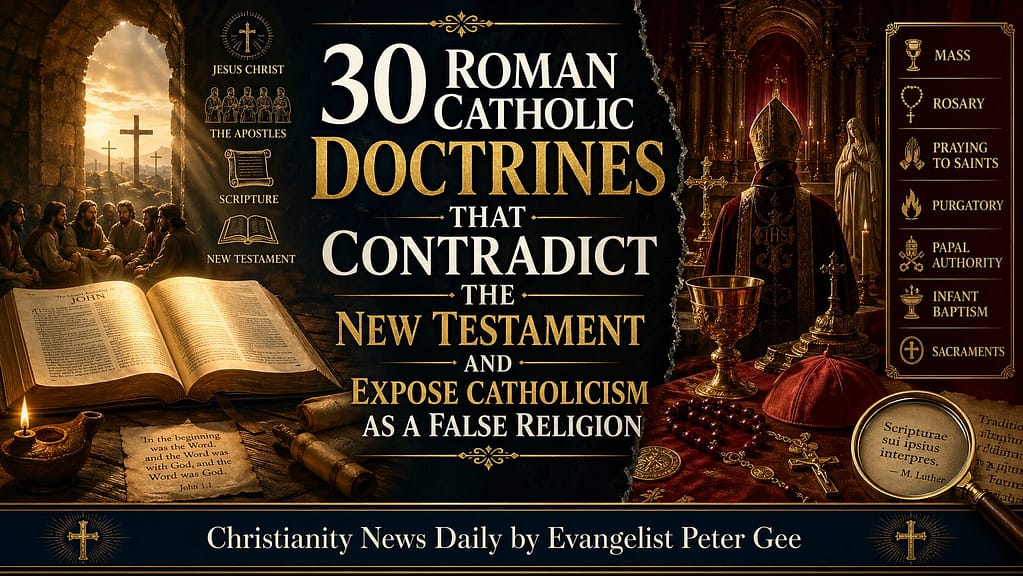
This article examines thirty Roman Catholic doctrines and practices that Scripture must test. These points are drawn from the doctrinal concerns outlined for this article, which identify major Catholic teachings such as devotion to Mary, prayers to saints, the Mass, purgatory, indulgences, papal infallibility, sacramental salvation, and the elevation of tradition over Scripture.
This article does not express hatred for the Catholic people. Catholics are precious souls made in the image of God, and many are deeply religious, sincere, moral, charitable, and devoted. But sincerity cannot save. Religion cannot save. Church membership cannot save anyone. Baptism cannot save. The pope cannot save any soul. Mary cannot save. The sacraments cannot save.
Only Jesus Christ can save souls.
“Nor is there salvation in any other, for there is no other name under heaven given among men by which we must be saved.”
Acts 4:12
Therefore, the Roman Catholic system must be tested by the Word of God.
1. The Exaltation of Mary Beyond Scripture
The Bible honors Mary as the virgin chosen by God to bear Jesus Christ according to the flesh. She was highly favored, blessed among women, and obedient to the word of the Lord.
But Scripture never presents Mary as a mediator, redeemer, queen of heaven, dispenser of grace, or one to whom Christians should pray.
The New Testament teaches:
“For there is one God and one Mediator between God and men, the Man Christ Jesus.”
1 Timothy 2:5
There is one Mediator. Not two. Not Jesus and Mary. Not Jesus and the saints. Jesus alone stands between God and man.
When Catholic devotion gives Mary titles, prayers, trust, and spiritual dependence that Scripture reserves for God alone, it moves beyond biblical honor and into dangerous spiritual territory. The church may honor Mary as the earthly mother of Jesus, but it must never exalt her into a role God did not bestow upon her.
2. Praying to Saints
Roman Catholics commonly pray to saints, asking for their intercession. But the Bible never commands Christians to pray to the dead.
Prayer in Scripture is directed to God. Jesus taught His disciples:
“In this manner, therefore, pray: Our Father in heaven…”
Matthew 6:9
The apostles prayed to God. The early church prayed to God. Believers are invited to approach the throne of grace through Christ.
“Let us therefore come boldly to the throne of grace.”
Hebrews 4:16
The New Testament calls all true believers “saints,” not only a special group canonized centuries later by church authorities.
“To the church of God which is at Corinth, to those who are sanctified in Christ Jesus, called to be saints…”
1 Corinthians 1:2
Praying to departed saints gives created beings a spiritual role that Scripture does not assign to them. The believer’s confidence must be in the living Christ, not in the dead.
3. The Rosary
The Rosary centers heavily on repeated prayers, especially the “Hail Mary.” This practice is not found in the New Testament and shifts spiritual attention toward Mary in a way that the apostles never taught.
Jesus warned:
“And when you pray, do not use vain repetitions as the heathen do.”
Matthew 6:7
The issue is not merely repetition itself, because Scripture sometimes records repeated cries to God. The issue is mechanical, ritualized prayer that treats repeated formulas as spiritually effective. True prayer is not a counting system. It is living communion with God through Jesus Christ.
The New Testament church prayed with understanding, faith, repentance, thanksgiving, and dependence on God. It did not teach believers to recite Marian formulas.
4. The Catholic Mass as a Representation of Christ’s Sacrifice
Roman Catholic theology teaches that the Mass makes the sacrifice of Christ present. But the New Testament declares that Christ’s sacrifice was completed once for all.
“Who does not need, as those high priests, to offer up sacrifices… For this He did once for all when He offered up Himself.”
Hebrews 7:27
Again:
“But this Man, after He had offered one sacrifice for sins forever, sat down at the right hand of God.”
Hebrews 10:12
Jesus did not leave an unfinished sacrifice. He cried:
“It is finished.”
John 19:30
Any religious system that presents Christ’s sacrifice as needing repeated sacramental representation risks undermining the finality and sufficiency of the cross.
5. Transubstantiation
Transubstantiation teaches that the bread and wine become the literal body and blood of Christ. But the New Testament presents the Lord’s Supper as a memorial proclamation of His death until He comes.
Jesus said:
“Do this in remembrance of Me.”
Luke 22:19
Paul wrote:
“For as often as you eat this bread and drink this cup, you proclaim the Lord’s death until He comes.”
1 Corinthians 11:26
The bread and cup point believers back to the body and blood of Christ, offered on the cross. They do not become an object to be worshiped. The power is not in a priestly transformation of elements but in the finished work of Jesus Christ.
6. Purgatory
Purgatory teaches that some souls undergo purification after death before entering heaven. But Scripture teaches that Christ’s blood cleanses believers from sin and that, after death, judgment comes.
“The blood of Jesus Christ, His Son, cleanses us from all sin.”
1 John 1:7
“And as it is appointed for men to die once, but after this the judgment.”
Hebrews 9:27
The New Testament does not teach a middle place where believers undergo purification to complete Christ’s unfinished work. The gospel says:
“There is therefore now no condemnation to those who are in Christ Jesus.”
Romans 8:1
Purgatory weakens the believer’s confidence in the finished work of Christ and introduces a post-death purification system that the apostles did not preach.
7. Indulgences
Indulgences are tied to the Catholic doctrine of purgatory and are said to reduce temporal punishment for sin. But the New Testament teaches forgiveness through repentance and faith in Christ, not through church-issued benefits.
Peter told Simon the sorcerer:
“Repent therefore of this your wickedness, and pray God if perhaps the thought of your heart may be forgiven you.”
Acts 8:22
Forgiveness is not purchased, earned, transferred, or managed by a religious treasury. God grants it through Christ.
“In Him we have redemption through His blood, the forgiveness of sins.”
Ephesians 1:7
8. Confession to Priests for Absolution
The Bible teaches the confession of sin, but it does not teach that believers must confess to a priest to receive absolution.
“If we confess our sins, He is faithful and just to forgive us our sins.”
1 John 1:9
The “He” is God.
Believers may confess faults to one another for prayer and healing:
“Confess your trespasses to one another, and pray for one another.”
James 5:16
But no New Testament priesthood is established where a man stands as the required absolver of another believer’s sins. Jesus Christ is the High Priest.
“Seeing then that we have a great High Priest who has passed through the heavens, Jesus the Son of God…”
Hebrews 4:14
9. Unbiblical Religious Titles
Catholicism uses titles such as “Holy Father” for the pope. But Jesus warned:
“Do not call anyone on earth your father; for One is your Father, He who is in heaven.”
Matthew 23:9
The issue is spiritual exaltation. No man should be given a title that places him in the position of spiritual supremacy over God’s people.
“Holy Father” is a phrase Jesus used when praying to God the Father:
“Holy Father, keep through Your name those whom You have given Me.”
John 17:11
Such holy language belongs to God, not to a religious ruler in Rome.
10. Papal Infallibility
The doctrine of papal infallibility holds that the pope can speak without error on matters of faith and morals under certain conditions. But Scripture teaches that all men are fallible and subject to God’s Word.
“For all have sinned and fall short of the glory of God.”
Romans 3:23
The apostles themselves were accountable to the truth of the gospel. Paul even publicly rebuked Peter for acting hypocritically.
“But when Peter had come to Antioch, I withstood him to his face, because he was to be blamed.”
Galatians 2:11
If Peter himself could be corrected, no later bishop can claim unquestionable doctrinal authority. Scripture, not the pope, is the final authority.
11. Canonization of Saints
The Catholic Church officially declares certain people to be saints. But the New Testament uses “saints” to refer to all true believers in Christ.
“To all who are in Rome, beloved of God, called to be saints.”
Romans 1:7
Sainthood is not a posthumous status granted by Rome. It is the identity of those sanctified in Christ Jesus. Every born-again believer is called to holiness.
“But as He who called you is holy, you also should be holy in all your conduct.”
1 Peter 1:15
12. Veneration of Relics
Relics are physical objects associated with saints or holy figures. Catholic devotion to relics can treat material objects as channels of grace or spiritual power.
But Scripture warns against worshiping created things rather than the Creator.
Who exchanged the truth of God for a lie and worshiped and served the creature instead of the Creator?
Romans 1:25
The Christian faith does not rest in bones, clothing fragments, artifacts, or objects. It rests in the risen Christ.
13. Baptismal Regeneration
Roman Catholicism teaches that baptism regenerates the soul. But Scripture teaches that salvation is by grace through faith.
“For by grace you have been saved through faith, and that not of yourselves; it is the gift of God.”
Ephesians 2:8
Baptism is commanded and important, but it is not a substitute for repentance and faith. Water cannot replace the blood of Christ. Ceremony cannot replace regeneration by the Holy Spirit.
Paul said:
“For Christ did not send me to baptize but to preach the gospel.”
1 Corinthians 1:17
That does not mean baptism is unimportant. It shows baptism is not the gospel itself.
14. Infant Baptism
In the New Testament, baptism is connected with repentance, faith, and the reception of the gospel.
“Repent, and let every one of you be baptized in the name of Jesus Christ.”
Acts 2:38
“Then those who gladly received his word were baptized.”
Acts 2:41
An infant cannot consciously repent, believe the gospel, or confess Jesus Christ as Lord. The New Testament pattern is believer’s baptism following faith.
15. Prayers for the Dead
Catholicism includes prayers for the dead, especially in connection with purgatory. But Scripture teaches that a person’s eternal state is determined by judgment after death.
“It is appointed for men to die once, but after this the judgment.”
Hebrews 9:27
The rich man in Luke 16 could not cross from torment to comfort after death. His condition was fixed.
“Between you and us there is a great gulf fixed.”
Luke 16:26
The living must repent now. After death, there is no biblical promise that prayers from the living can change the soul’s eternal condition.
16. The Immaculate Conception of Mary
The doctrine of the Immaculate Conception teaches that Mary was conceived without original sin. But Scripture teaches universal human sinfulness.
“For all have sinned and fall short of the glory of God.”
Romans 3:23
Mary herself rejoiced in God as her Savior:
“My soul magnifies the Lord, and my spirit has rejoiced in God my Savior.”
Luke 1:46–47
If Mary needed a Savior, she was sinful by nature. The only sinless One revealed in Scripture is Jesus Christ.
“He committed no sin, and no deceit was found in His mouth.”
1 Peter 2:22
17. The Assumption of Mary
The Assumption teaches that Mary was taken bodily into heaven. But the New Testament does not record such an event or command the church to believe it.
Biblical doctrine must not be built on silence. Scripture is sufficient for faith and practice.
“All Scripture is given by inspiration of God… so that the man of God may be complete.”
2 Timothy 3:16–17
If a doctrine is necessary for the church, God can reveal it clearly in His Word. The Assumption of Mary is not apostolic doctrine.
18. Statues and Images in Worship
Catholic churches often contain statues and images used devotionally. But Scripture repeatedly warns against bowing before images.
“You shall not make for yourself a carved image… You shall not bow down to them nor serve them.”
Exodus 20:4–5
The New Testament continues the warning:
“Little children, keep yourselves from idols.”
1 John 5:21
Even if Catholics claim they are not worshiping the statue itself, bowing, praying, lighting candles, and directing devotion through images create a danger of idolatry. God is Spirit; those who worship Him must worship in Spirit and in truth.
“God is Spirit, and those who worship Him must worship in spirit and truth.”
John 4:24
19. The Seven Sacraments as Necessary Channels of Salvation
Roman Catholicism teaches seven sacraments as means of grace. But the gospel teaches that sinners are justified by faith in Christ, not by ritual participation.
“Therefore, having been justified by faith, we have peace with God through our Lord Jesus Christ.”
Romans 5:1
“A man is not justified by the works of the law but by faith in Jesus Christ.”
Galatians 2:16
When religious rituals become necessary mechanisms of salvation, the sufficiency of Christ is obscured. An institution does not administer true salvation. It is granted by God to those who repent and believe the gospel.
20. The Sign of the Cross
The sign of the cross is not commanded in the New Testament. The cross itself is central to Christianity, but repeated gestures can become ritualistic or superstitious when treated as a means of spiritual protection.
Paul said:
“God forbid that I should boast except in the cross of our Lord Jesus Christ.”
Galatians 6:14
The believer’s confidence is not in making a sign over the body. The believer’s confidence is in the crucified and risen Savior.
21. Holy Water
Holy water is used in Catholic practice for blessing, protection, and purification. But the New Testament gives no doctrine that blessed water carries spiritual power.
The blood of Christ cleanses us from sin.
“To Him who loved us and washed us from our sins in His own blood.”
Revelation 1:5
The Holy Spirit sanctifies believers.
“But you were washed, you were sanctified, you were justified in the name of the Lord Jesus.”
1 Corinthians 6:11
No blessed water can replace the cleansing work of Christ and the Spirit.
22. Mandatory Celibacy of Priests
The Roman Catholic priesthood requires celibacy in its Latin rite. But the New Testament allows church leaders to be married.
“A bishop then must be blameless, the husband of one wife.”
1 Timothy 3:2
“Let deacons be the husbands of one wife.”
1 Timothy 3:12
Paul warned that forbidding marriage would be a mark of false teaching.
“In latter times, some will depart from the faith… forbidding marriage.”
1 Timothy 4:1–3
Marriage is honorable. A church has no authority to impose celibacy as a universal requirement where Scripture does not.
23. The Perpetual Virginity of Mary
The virgin birth of Jesus Christ is biblical and essential. But the doctrine that Mary remained a virgin for her entire life is not clearly taught in Scripture.
The Bible refers to Jesus’ brothers and sisters.
“Is this not the carpenter’s son? Isn’t His mother called Mary? And His brothers James, Joses, Simon, and Judas?”
Matthew 13:55
The New Testament focus is not on Mary’s perpetual virginity. The focus is Jesus Christ, the Son of God, born of a virgin, crucified for sinners, raised from the dead, and exalted as Lord.
24. Marian Apparitions
Roman Catholicism has a long history of alleged Marian apparitions. But any spiritual message must be tested by Scripture.
“Beloved, do not believe every spirit, but test the spirits to see whether they are of God.”
1 John 4:1
Even supernatural appearances are not proof of truth.
“For Satan himself transforms himself into an angel of light.”
2 Corinthians 11:14
If any apparition promotes devotion that shifts glory from Christ, contradicts Scripture, or encourages dependence on Mary, it must be rejected.
25. The Scapular
Some Catholics treat the scapular as a sign of protection or special grace. But the New Testament does not teach that wearing a religious object grants spiritual security.
The believer’s security is in Christ.
“And I give them eternal life, and they shall never perish; neither shall anyone snatch them out of My hand.”
John 10:28
Objects cannot save. Garments cannot save. Tokens cannot save. Jesus saves.
26. Extreme Unction and Last Rites
Catholic last rites are believed to prepare the soul for death and may include the forgiveness of sins. But Scripture teaches that forgiveness comes through repentance and faith in Christ.
“Repent, therefore, and be converted, that your sins may be blotted out.”
Acts 3:19
James does speak of elders praying over the sick and anointing with oil:
“Let him call for the elders of the church, and let them pray over him, anointing him with oil.”
James 5:14
But this is not a priestly death ritual that guarantees preparation for heaven. A person must be reconciled to God through Christ before death, not depend on a final ritual.
27. Ritualized Liturgy That Replaces Spirit and Truth
Orderly worship is biblical. But highly ritualized worship can become spiritually empty when ceremony replaces truth, repentance, and living faith.
Jesus said:
“These people draw near to Me with their mouths and honor Me with their lips, but their hearts are far from Me.”
Matthew 15:8
True worship is not merely liturgical beauty, incense, robes, chants, kneeling, candles, or ceremony. True worship is in Spirit and in truth.
“The true worshipers will worship the Father in spirit and truth.”
John 4:23
28. Elevating Tradition Alongside or Above Scripture
One of the central errors of Roman Catholicism is the elevation of church tradition as a binding authority. But Jesus rebuked religious leaders for allowing tradition to corrupt obedience to God.
“Thus you have made the commandment of God of no effect by your tradition.”
Matthew 15:6
Scripture is God-breathed and sufficient.
“All Scripture is given by inspiration of God… that the man of God may be complete, thoroughly equipped for every good work.”
2 Timothy 3:16–17
When tradition becomes equal to or higher than Scripture, man’s word competes with God’s Word.
29. Eucharistic Adoration
Eucharistic adoration involves worship directed toward the consecrated host. But if the bread remains bread as a memorial symbol, then worshiping it is idolatry.
God does not dwell in objects made by human hands.
“God, who made the world and everything in it… does not dwell in temples made with hands.”
Acts 17:24
Jesus Christ is not to be worshiped as a wafer on an altar. He is the risen Lord seated at the right hand of the Father.
“Christ… is even at the right hand of God.”
Romans 8:34
30. Prayers to the Holy Family
Catholic devotion sometimes includes prayers to the Holy Family: Jesus, Mary, and Joseph. But Scripture does not teach prayer to a family unit. Prayer is directed to God through Christ.
Jesus said:
“Whatever you ask in My name, I will do, so that the Father may be glorified in the Son.”
John 14:13
Joseph was a faithful man. Mary was blessed among women. But neither Joseph nor Mary is a recipient of Christian prayer. The believer prays to the Father in the name of Jesus Christ by the help of the Holy Spirit.
The central issue is not merely one doctrine. It is the gospel itself.
The New Testament gospel is clear:
Man is a sinner.
God is holy.
Jesus Christ is the eternal Son of God.
He died for sins once for all.
He rose bodily from the dead.
He is the only Mediator between God and man.
Salvation is by grace through faith, not by works, rituals, sacraments, Mary, saints, purgatory, indulgences, or church membership.
Paul warned:
“But even if we, or an angel from heaven, preach any other gospel to you than what we have preached to you, let him be accursed.”
Galatians 1:8
Any system that adds human works, priestly mediation, sacramental dependence, Marian devotion, or institutional authority to the finished work of Christ must be rejected.
No Catholic is saved by being a Catholic.
No Protestant is saved by being a Protestant.
No Baptist, Pentecostal, Methodist, Anglican, Presbyterian, or non-denominational churchgoer is saved by belonging to a religious group.
Only those who are born again through faith in Jesus Christ belong to God.
Jesus said:
“Unless one is born again, he cannot see the kingdom of God.”
John 3:3
This is the urgent call to every Catholic soul: come directly to Jesus Christ. Do not trust Rome. Do not trust Mary. Do not trust saints. Do not trust sacraments. Do not trust the Mass. Do not trust purgatory. Do not trust indulgences. Do not trust priests. Do not trust the pope.
Trust Christ.
He alone died for your sins.
He alone rose from the dead.
He alone is Lord.
He alone is the Mediator.
He alone is the Savior.
He alone can wash away sin.
He alone can grant eternal life.
“Believe in the Lord Jesus Christ, and you will be saved.”
Acts 16:31
The door of salvation is still open. But it is not opened by religion. Christ opens it.
Repent. Believe the gospel. Follow Jesus Christ as revealed in the Scriptures. Come out of every false system and stand upon the Word of God.
The Lord Jesus said:
“If you abide in My word, you are My disciples indeed. And you shall know the truth, and the truth shall make you free.”
John 8:31–32
The truth is not Rome.
The truth is not tradition.
The truth is not ritual.
The truth is not Mary.
The truth is not the pope.
The truth is Jesus Christ.
If Jesus Christ and His apostles did not teach the Roman Catholic Mass, did not command the Rosary, did not instruct believers to pray to Mary or the dead saints, did not baptize infants as a means of salvation, did not establish purgatory, did not sell indulgences, did not create papal authority, did not appoint cardinals, did not require priests to remain unmarried, did not command the veneration of statues and relics, and did not teach that sacraments administered by a religious institution are necessary for salvation, then every honest reader must ask the unavoidable question:
Where did these doctrines come from?
They did not come from the New Testament. They did not come from the Lord Jesus Christ. They did not come from the apostles. They did not come from the church born by the Holy Spirit at Pentecost.
They came from religious tradition, institutional power, centuries of man-made development, and doctrines that people added after the apostolic foundation had already been laid.
This is the great danger of Roman Catholicism. It presents itself as ancient Christianity, yet many of its defining doctrines cannot be found in the teachings of Christ or His apostles. It claims apostolic authority while practicing beliefs the apostles never preached. It speaks of grace while placing sinners under a system of rituals, priests, sacraments, penance, purgatory, devotion to Mary, saintly intercession, and church authority.
But the New Testament gospel is clear. Salvation is not found in Rome. Salvation is not found in Mary. Salvation is not found in the pope. Salvation is not found in the Mass. Salvation is not found in sacraments, relics, rituals, indulgences, or prayers for the dead.
Salvation is found only in Jesus Christ.
The Bible says:
“Nor is there salvation in any other, for there is no other name under heaven given among men by which we must be saved.”
Acts 4:12
Therefore, every Catholic must examine these doctrines in the light of Scripture. If a doctrine cannot trace its origins to Jesus Christ and the apostles in the New Testament, it has no authority over the soul. If a religious practice leads people away from Christ’s finished work and toward man-made systems, it is spiritually dangerous. If a church places tradition beside or above Scripture, it has departed from the faith once delivered to the saints.
The call is not to defend religion.
The call is to repent.
The call is to come out of man-made tradition.
The call is to believe the gospel.
The call is to trust Jesus Christ alone.
The Lord Jesus did not say, “Come to a religious system.”
He said:
“Come to Me, all you who labor and are heavy laden, and I will give you rest.”
Matthew 11:28
That is the invitation Catholics must hear. Not come to Rome. Not come to Mary. Not come to a priest. Not come to the sacraments. Not come to purgatory. Not come to religious traditions.
Come to Jesus Christ.
Only He died for sinners.
Only He rose from the dead.
Only He is seated at the right hand of the Father.
Only He is the Mediator between God and man.
Only He can forgive sins.
Only He can grant eternal life.
Any religion that adds to Him, competes with Him, or redirects sinners away from Him is not the New Testament faith. It is another gospel, and Scripture warns that another gospel cannot save.
“But even if we, or an angel from heaven, preach any other gospel to you than what we have preached to you, let him be accursed.”
Galatians 1:8
This is why Roman Catholicism must be tested, exposed, and rejected wherever it contradicts the Word of God. Souls are at stake. Eternity is at stake. The gospel is at stake.
The safe path is not tradition.
The safe path is not religious loyalty.
The safe path is not institutional power.
The safe path is Jesus Christ, according to the Scriptures.
Final Biblical Warning
The New Testament did not leave the church without warning. The Holy Spirit expressly warned that in the latter times some would depart from the faith, give heed to deceiving spirits and doctrines of demons, speak lies in hypocrisy, have their conscience seared, forbid marriage, and command abstinence from foods that God created to be received with thanksgiving. The Apostle Paul foresaw the rise of spiritually corrupt religious systems such as Catholicism, hence his letter to Timothy about the great apostasy.
1 Timothy 4:1-5 New King James Version
The Great Apostasy
4 Now the Spirit expressly says that in latter times some will depart from the faith, giving heed to deceiving spirits and doctrines of demons, 2 speaking lies in hypocrisy, having their conscience seared with a hot iron, 3 forbidding marriage, and commanding to abstain from foods that God created to be received with thanksgiving by those who believe and know the truth. 4 For every creature of God is good, and nothing is to be refused if it is received with thanksgiving; 5 for it is sanctified by the word of God and prayer.
The scripture above answers the question about the original founder of the Catholic religion in 1 Timothy 4:1-2, as well as the entity behind ‘deceiving spirits and the doctrines of demons.’